From Napkin Sketch to Provisional Patent A 7-Day Action Plan
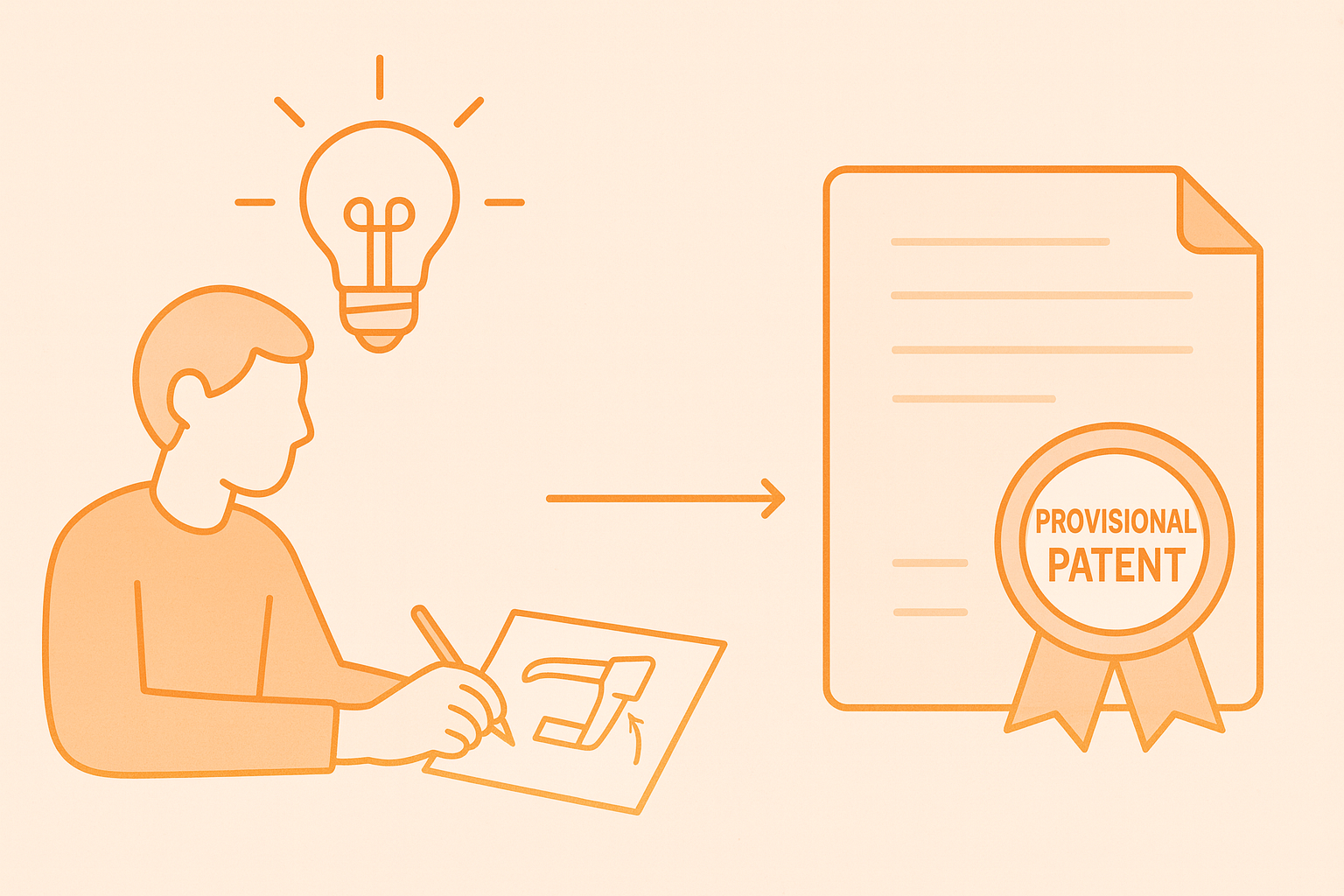
Have a great idea but feel overwhelmed by the patent process? You do not need months of work or thousands of dollars to get to "Patent Pending."
With a focused plan, you can go from rough concept to a filed provisional patent application (PPA) in just seven days.
This 7-day action plan is designed for beginners and solo inventors. Each day has a clear goal and a realistic time commitment (usually 1-3 hours).
By the end of Day 7, you will have:
- A detailed written description of your invention.
- Clear drawings that show how it works.
- Enough documentation to file a provisional patent with the USPTO and claim "Patent Pending" status.
The 7-Day Action Plan
-
Day 1: The Brain Dump (Approx. 2 Hours)
Goal: Get your idea out of your head and into writing.
Action steps:
- Open a blank document and write without worrying about structure.
- Answer questions like: What problem does this solve? Who is it for? How does it work? What are the main parts or steps?
- Sketch rough drawings on paper -- even simple boxes and arrows are fine.
- Do not edit yet. Just capture everything.
-
Day 2: Structure and Detail (Approx. 3 Hours)
Goal: Turn your messy notes into a structured description.
Action steps:
- Create basic headings such as Background / Problem, Summary of the Invention, Detailed Description, and How It Works / Use Cases.
- Rewrite your Day 1 notes under these headings.
- Start numbering parts on your sketches (for example, 100, 110, 120).
- Refer to those numbers in your text: "As shown in FIG. 1, handle (100) connects to..."
You are starting to make it look like a real patent-style document.
-
Day 3: Prior Art Search (Approx. 2 Hours)
Goal: See what is already out there and clarify what makes your idea different.
Action steps:
- Go to Google Patents and search keywords related to your invention.
- Skim a handful of similar patents or published applications.
- Ask: What looks similar? What do they do differently?
- Update your description to highlight what is new and better about your invention.
This is not a full legal search, but it helps you position your idea and avoid reinventing what already exists.
-
Day 4: Refine and Expand (Approx. 2 Hours)
Goal: Make your description as complete as possible.
Action steps:
- Think about variations and alternatives: Could it use different materials? Could any part be a different shape, size, or configuration? Are there multiple ways to achieve the same result?
- Add a section like "Alternative Embodiments" or "Variations" and describe these versions.
This broadens your potential protection and makes your provisional more robust.
-
Day 5: Create Patent-Style Sketches (Approx. 1 Hour)
Goal: Turn rough sketches into cleaner, patent-style drawings.
Action steps:
- Use AI tools or simple digital drawing tools to create front, side, and perspective views.
- Add clear outlines and consistent line weights.
- Place reference numbers that match your written description.
- At minimum, make sure you have one main view showing the invention and additional views if needed to show important features.
Your drawings do not need to be perfect -- just clear, consistent, and readable.
-
Day 6: Final Review and Assembly (Approx. 1 Hour)
Goal: Assemble a single, complete provisional package.
Action steps:
- Combine your written description and drawings into one document (often exported as a PDF).
- Read through everything once more and check: Does it explain how to make and use your invention? Do figure numbers and reference numbers match the text? Are there any gaps or obvious questions left unanswered?
- Fix minor typos and clarity issues.
By the end of this day, you should have a provisional-ready spec with drawings.
-
Day 7: File Your Provisional Patent (Approx. 1 Hour)
Goal: File your PPA with the USPTO and become "Patent Pending."
Action steps:
- Create or log into a USPTO Patent Center account.
- Fill out the provisional patent cover sheet (for example, USPTO Form SB/16).
- Upload your description and drawings (usually as a PDF).
- Pay the provisional filing fee (often around $65 for micro entities; check current USPTO fees).
- Save your confirmation number, application number, and filing date.
Once filed correctly, you can typically say your invention is "Patent Pending."
From 7 Days to 10 Minutes: Where AutoInvent Fits In
This 7-day action plan is perfect if you want to learn the process and do everything manually. But if you would rather compress much of this into a single guided flow, AutoInvent can help. AutoInvent:
- Turns your idea and basic description into patent-style text and structured sections in minutes.
- Uses AI to help you generate patent-style sketches that match your description.
- Walks you step-by-step through actually filing your provisional patent yourself with the USPTO.
- Lets you go from idea to a filed provisional patent in under 10 minutes for under $100 (plus the USPTO filing fee).
- You stay the inventor and the applicant -- AutoInvent just takes the overwhelm out of getting from napkin sketch to "Patent Pending."