Can You File a Patent Without a Lawyer? Yes -- Here's How
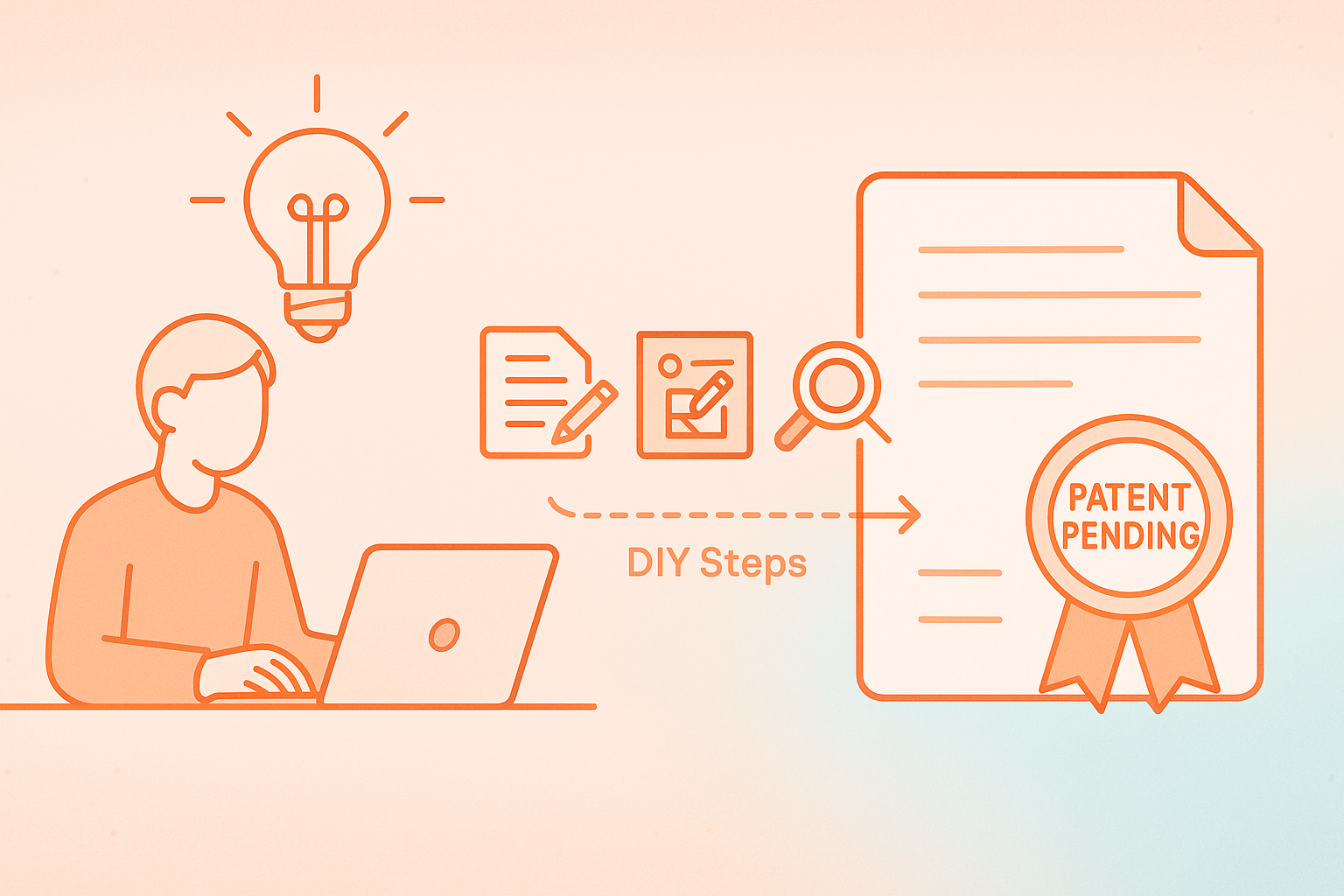
Can you file a patent without a lawyer? Yes. Thousands of inventors file patents on their own every year, especially provisional patent applications.
If you're a solo inventor or early-stage founder, learning how to file a patent yourself can save you thousands of dollars while still getting you to 'patent pending' fast.
- You can file a patent without a lawyer, especially a provisional patent.
- Provisional patents are simpler and cheaper, making them ideal for DIY filers.
- Patent attorneys often charge $5,000-$15,000 per application.
- The USPTO offers free resources for independent inventors.
- Modern tools make drafting and filing much faster and more affordable.
When Filing a Patent Without a Lawyer Makes Sense
DIY patent filing is often a good fit if:
- You're on a tight budget. Attorney fees are out of reach, but you still want 'patent pending' protection.
- You're filing a provisional patent application. Provisional patents do not require formal claims and are never examined on their own. Your main job is to clearly describe your invention.
- Your invention is straightforward. Mechanical devices, consumer products, and simple software flows are usually easier to describe without complex legal language.
- You're willing to follow a clear process. You do not need a law degree, but you do need to read instructions carefully and take the documentation seriously.
When You Should Consider a Patent Lawyer
It is worth talking to a patent attorney if:
- Your invention is highly technical. Think biotech, complex algorithms, or advanced hardware.
- You're in a crowded or competitive space. Strong, enforceable claims matter.
- You've raised funding specifically for IP. You want a robust non-provisional filing.
- You're planning international filings. You need strategy across multiple countries.
Even in these cases, you can still start with a DIY draft and have a lawyer refine it later.
Why Do Most Inventors Think They Need a Lawyer?
The patent system has a reputation for being complex, technical, and legally demanding. Patent attorneys have reinforced this perception because, frankly, it is good for business. While it is true that patent law is intricate, the reality is:
- For provisional patents: The requirements are straightforward and manageable for most inventors.
- For simple inventions: Many mechanical, consumer product, and software inventions can be effectively protected without complex legal language.
- With modern tools: AI-powered patent generators and online resources have dramatically simplified the process.
- For budget-conscious inventors: The choice is often between filing yourself or not filing at all due to cost constraints.
How to File a Provisional Patent Without a Lawyer
-
Describe Your Invention in Detail
Write a thorough description that covers:
- What your invention does (the problem it solves).
- How it works (components, steps, or logic).
- What makes it different from existing solutions.
- Variations and alternatives (different configurations, methods, materials).
A good rule of thumb: someone skilled in your field should be able to build your invention from your description.
-
Create Clear Drawings
For a provisional patent, drawings do not have to be perfect, but they must be clear:
- Use hand sketches or simple digital diagrams.
- Include multiple views if helpful (front, side, perspective, flowchart).
- Label key parts with reference numbers that match your text.
-
Do a Basic Prior Art Search
Before you file, search:
- Google Patents.
- The USPTO patent database.
- Existing products online.
Look for similar inventions and note how your idea is different. This helps you describe what is actually new.
-
Assemble Your Provisional Package
A U.S. provisional patent application generally includes:
- Cover sheet (USPTO Form SB/16).
- Specification (your detailed written description).
- Drawings.
- Filing fee (reduced if you qualify as a micro entity).
You do not need perfect formatting, but you do need depth and clarity.
-
File Online with the USPTO
Once your documents are ready:
- Create or log into your USPTO Patent Center account.
- Select the option to file a provisional application.
- Upload your cover sheet, specification, and drawings.
- Pay the filing fee.
- Save your confirmation and filing date.
After that, assuming you have filed correctly, you can typically say your invention is 'Patent Pending.'
Common DIY Patent Mistakes
- Too little detail. Short, vague descriptions do not protect much.
- Missing the 12-month deadline. A provisional expires after 12 months; you must file a non-provisional before it expires.
- Weak drawings. Confusing or inconsistent figures hurt your application.
- Incorrect entity status. Only claim micro or small entity if you truly qualify.
- No prior art search. Filing blind increases the risk that your 'new' idea already exists.
A Smart Strategy: DIY Now, Lawyer Later
A practical approach for many inventors:
- Now: File your own provisional patent to secure a filing date and 'Patent Pending' at low cost.
- Later (within 12 months): If your idea gains traction, hire a patent attorney to draft and file a full non-provisional using your provisional as a starting point.
This balances cost, speed, and protection.
How AutoInvent Fits In
You do not have to figure everything out from scratch. AutoInvent is built for inventors who want to file a patent without a lawyer and actually complete the filing in one guided flow. AutoInvent:
- Creates all the necessary patent-style documents for you in minutes (provisional spec, structured sections, figure descriptions).
- Walks you step-by-step through the actual USPTO filing process, so you are not guessing which forms or uploads you need.
- Lets you go from idea to a fully drafted and filed provisional patent yourself in under 10 minutes.
- Keeps your drafting and guidance cost to under $100, with you still paying the USPTO filing fee directly.
- You stay the inventor and the applicant; AutoInvent just makes getting from idea to a filed provisional patent dramatically faster and easier.