The Lean Founder's Guide to Protecting Your Idea for Under $100 Smart IP moves without a big legal bill
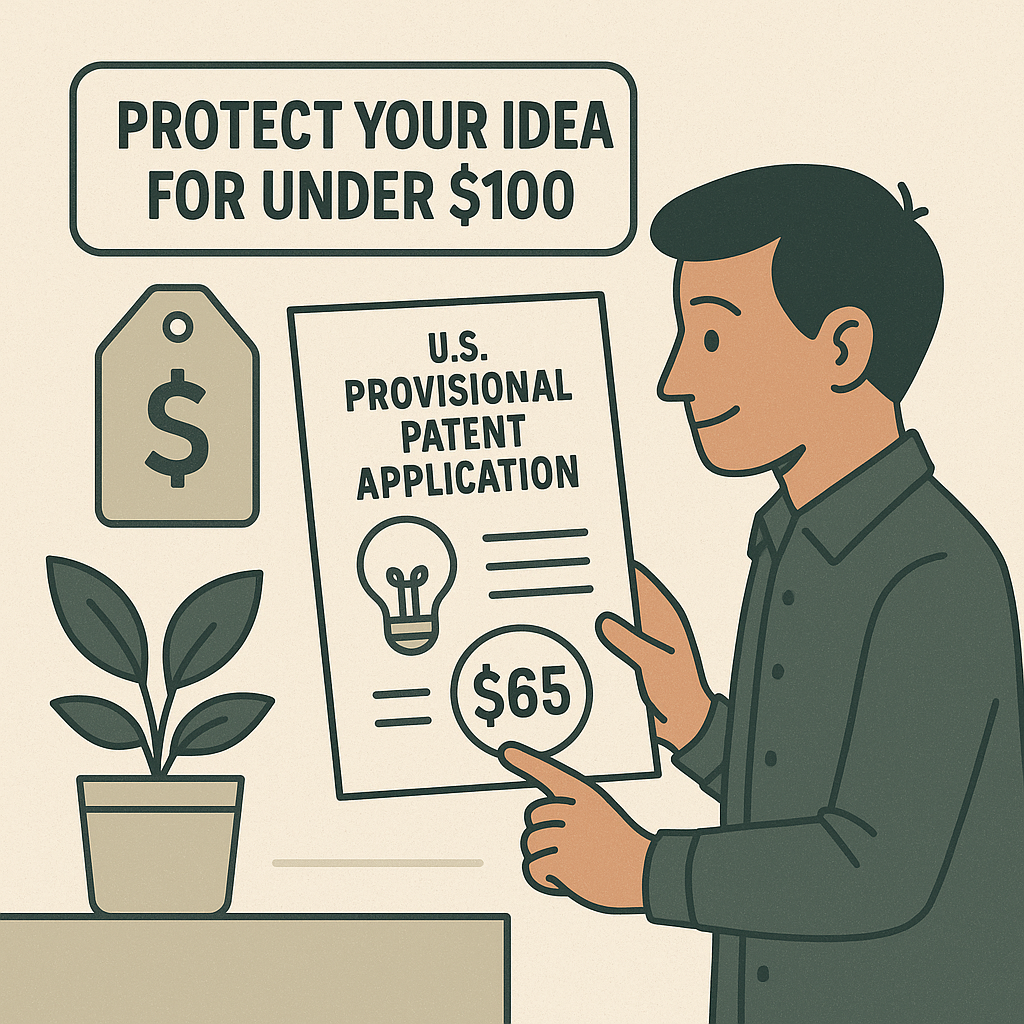
When you are an early-stage founder, every dollar you do not spend matters as much as the ones you do. The good news: you do not need a huge legal budget to start protecting your idea.
With a smart approach, you can secure real, meaningful IP protection for under $100 and keep your capital focused on building.
- A provisional is the lean founder's best tool: Low cost, fast filing, real "Patent Pending" status.
- $65 can be enough: Micro-entity status makes a PPA surprisingly affordable.
- Protection comes from details: A good PPA reads like an instruction manual.
- DIY is allowed: You can file pro se and bring in lawyers later.
- Use the 12 months wisely: Validate, build, and decide whether to go non-provisional.
Big Protection on a Small Budget
Most people hear "patent" and think:
- $5,000-$15,000 in legal fees.
- Months of back-and-forth with lawyers.
- Something you will "figure out later."
If you are at the idea or MVP stage, your best tool is much simpler and much cheaper: the provisional patent application (PPA).
The Magic Number: $65
If you qualify as a micro entity (which many solo inventors and small startups do), the USPTO filing fee for a provisional patent can be as low as about $65 (check current USPTO fees).
That $65 gets you access to the most powerful budget-friendly move in the IP playbook.
What Does $65 Actually Get You?
-
One Year of "Patent Pending"
Once your PPA is filed, you can usually label your invention as "Patent Pending." You can put this on your website, pitch decks, product packaging, and marketing materials.
It sends a simple, strong message: "We are already taking steps to protect our core technology."
-
A Priority Filing Date
Your filing date is everything in a first-to-file system. A PPA locks in your priority date for what you have described, helps defend against later filers, and becomes the anchor point for a future non-provisional.
You do not get that priority date by thinking about filing. You get it by actually filing.
-
A Protected Window to Build and Share
With a PPA in place, you gain a 12-month window to talk to customers, show prototypes, pitch investors, and refine the product.
It does not mean you are lawsuit-ready tomorrow, but it does mean you are no longer walking around completely exposed.
How to Keep Your Total Cost Under $100
-
File Pro Se (Do It Yourself)
The biggest cost in patenting is not the government fee -- it is lawyer fees. For a provisional, you are allowed to file pro se. If you are willing to follow clear guidance, you can prepare a solid PPA yourself at this stage.
You can always involve attorneys later when you file a non-provisional if the idea proves out.
-
Qualify as a Micro Entity
To get the low micro-entity filing fee, you generally must:
- Have filed fewer than five previous U.S. non-provisional patent applications.
- Have income below a certain threshold (historically in the low to mid $200k range).
- Not have assigned your invention to a large entity.
Most first-time founders and solo inventors easily qualify.
-
Use AI for Drawings Instead of Hiring a Draftsperson
Professional patent illustrators are great but not cheap. To keep costs down, use AI or simple digital tools to generate clean, patent-style sketches from your description.
Focus on clarity: multiple views (front, side, perspective, internal if needed) and labels that match your text.
The Lean IP Play: Max Protection, Minimal Spend
With this approach, your total cost can look like:
- $65 for the USPTO micro-entity provisional filing fee.
- $0-$30 for optional tools, printing, or minor extras.
Total: under $100 to go from "I have an idea and I am afraid to talk about it" to "I have a filed provisional, a priority date, and Patent Pending status while I build."
That is about the cost of a fancy dinner or one SaaS subscription you forgot to cancel.
Where AutoInvent Fits In
If you want to stay lean but do not want to guess your way through a patent-style document, AutoInvent is built for exactly this use case. AutoInvent:
- Turns your description into structured, patent-style text (background, detailed description, variations).
- Helps you generate patent-style sketches from your explanation -- no design skills required.
- Guides you step-by-step through actually filing your provisional patent yourself with the USPTO.
- Keeps your total cost under $100 for the workflow (plus the USPTO filing fee if you are a micro entity).
In other words, you get a lean, founder-friendly path to Patent Pending without blowing your early budget -- so you can protect your upside while staying focused on building and finding customers.